
NASM Overactive & Underactive Muscles Chart: Free CPT Study Guide
Oct 13, 2026If you're studying for the NASM CPT exam, you've probably run into one of the most confusing parts of the material:
Which muscles are overactive, and which muscles are underactive?
You'll see these muscle relationships throughout movement assessments, corrective exercise, and questions about movement compensations.
And if you've ever looked at one of the NASM muscle tables and thought, “How am I supposed to memorize all of this?” — you're not alone!
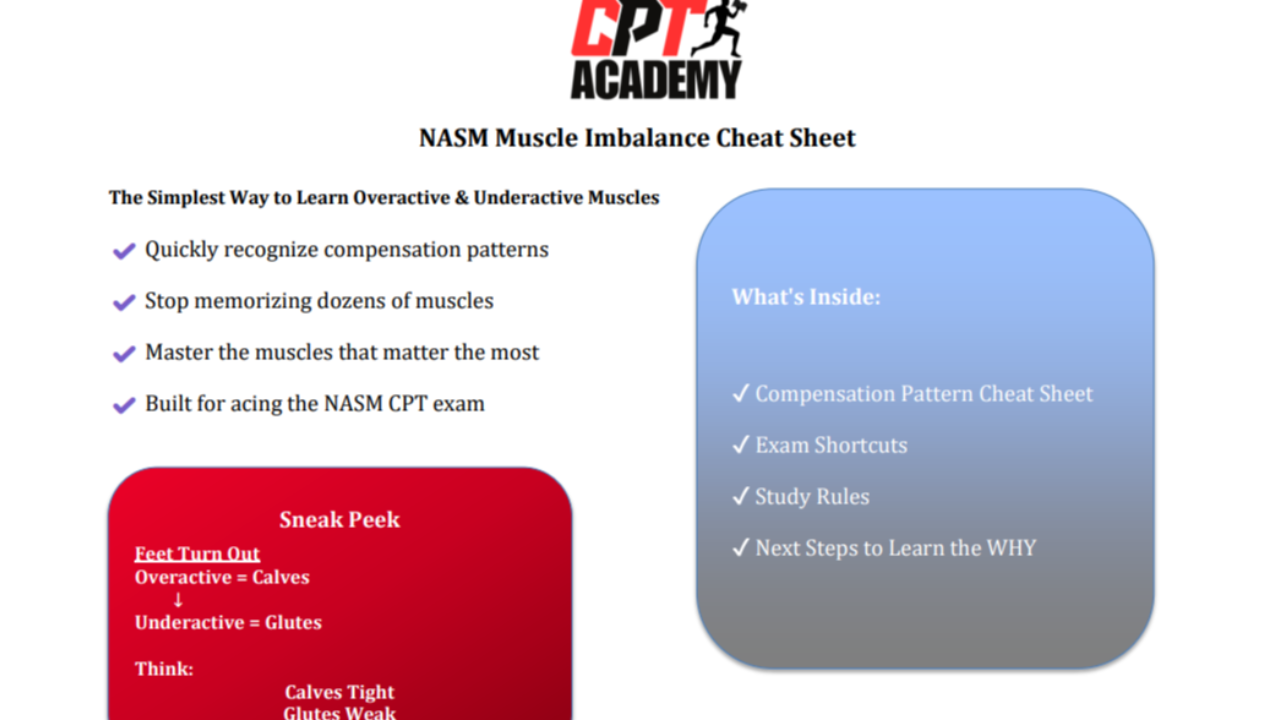
That's why we created a free NASM Overactive & Underactive Muscles Chart to help you organize this information in one place.
Get the Free NASM Overactive & Underactive Muscles Chart
Keep the chart handy while you study. It gives you a quick reference for the major movement compensations and the associated overactive and underactive muscles.
But here's the important part:
Don't use the chart just to memorize lists. Use it to understand the patterns.
What Is an Overactive Muscle?
For NASM CPT study purposes, think of an overactive muscle as a muscle that is tight, shortened, and not relaxing or lengthening appropriately.
A simple way to remember it:
Overactive = Tight
This is why overactive muscles are commonly associated with stretching in the corrective exercise process.
What Is an Underactive Muscle?
An underactive muscle is generally lengthened, weak, and not activating effectively when it should.
The simple study shortcut is:
Underactive = Weak
This is why underactive muscles are commonly addressed with activation and strengthening exercises.
If you're still trying to understand why one muscle becomes overactive while another becomes underactive, read our complete guide:
“Overactive vs. Underactive Muscles: Think Tight vs. Weak”
That article goes deeper into the relationship between the two and explains the concepts in simple terms.
Don't Try to Memorize Every Muscle Separately
This is probably the biggest mistake students make.
They look at a list of overactive muscles and try to memorize the entire list.
Then they look at the underactive muscles and try to memorize another list.
And eventually everything starts blending together.
There's a better way.
Start with the movement.
When you see a compensation, ask:
What movement is occurring?
Then ask:
Which muscles are working to put the body into that position?
Those muscles are often the overactive muscles.
Then ask:
Which muscles work reciprocally (oppose) the above, i.e. biceps and triceps?
Those are the muscles you need to think about as underactive.
This gives you a logical way to work through the information instead of relying entirely on memorization.
Use the Chart as a Study Tool — Not a Replacement for Understanding
The free chart is designed to give you a quick reference.
It's especially useful when you're studying the Overhead Squat Assessment and other movement compensation patterns.
For example, instead of trying to memorize every muscle on the page at once, choose one compensation at a time.
Study:
- The movement you see
- Why the movement occurs
- The primary overactive muscles
- The primary underactive muscles
- What you would do about the imbalance
Then move on to the next compensation.
Start With the Compensation, Then Learn the Muscles
This is exactly why we've created the individual articles in our NASM movement compensation series.
For example, if you're studying feet turn out, don't start by staring at a muscle list.
Start by understanding why the feet turn out.
Then learn which muscles are involved.
Then practice recognizing the pattern.
Feet Turn Out
Feet Turn Out Part 1 – Why the Feet Turn Out
Once you understand the mechanics, continue with:
Feet Turn Out Part 2 – Overactive & Underactive Muscles
Then test yourself with:
Feet Turn Out Part 3 – NASM CPT Exam Questions/Study Tips
And our Free Practice Test.
This three-step approach—understand → identify → apply—is much more useful than simply trying to memorize a table.
Other NASM Compensation Patterns to Study
The same approach applies to the other movement compensations you'll encounter while studying for the NASM CPT exam.
Knees Cave In
Knees Cave In Part 1 - Background
Knees Cave In Part 2 – Overactive & Underactive Muscles
Knees Cave In Part 3 - Test Application
Overhead Squat Assessment
If you haven't worked through the Overhead Squat Assessment yet, start there.
NASM Overhead Squat Assessment Guide
This gives you the bigger picture before you start breaking down individual compensations. Your existing OHSA guide already positions the free chart as a printable reference for the major compensations, so this creates a natural connection between the two resources.
Other Compensation Patterns
As you continue studying, work through our blog articles and YouTube videos on many other topics!
How to Study the Chart for the NASM CPT Exam
Here's a simple way to use the chart during your study sessions.
Step 1: Cover the muscle names
Look only at the compensation (i.e. feet turn out, low back arches, etc.).
Ask yourself:
What muscles do I think are overactive?
Write down your answer.
Step 2: Think through the movement
Ask:
What msucles(s) are working to get the body into this position?
This helps you reason through the answer rather than simply recalling it.
Step 3: Check the chart
Now uncover the answer.
Compare your answer with the chart.
Step 4: Study your mistakes
If you missed something, don't just memorize the correct answer.
Ask:
Why would that muscle be overactive or underactive in this compensation?
That's where the information starts to stick.
Step 5: Repeat
Go through the compensations until you can recognize the patterns without immediately looking at the chart.
Free NASM Overactive & Underactive Muscles Chart
If you're studying for the NASM CPT exam, keep this resource nearby.
FREE NASM OVERACTIVE & UNDERACTIVE MUSCLES CHART
Use it while reading the individual articles, watching the videos, and testing yourself with practice questions.
The goal isn't simply to memorize a page of muscle names.
The goal is to understand what you're seeing and why it is happening.
Watch the Videos
If you learn better by watching rather than reading, or prefer to watch and read, we've also created a video series covering the major movement compensation patterns.
YouTube Muscle Imbalance Playlist
The videos allow you to actually see the movement while learning how to identify the associated muscle relationships.
Test Yourself
Once you've studied the chart and worked through the individual compensation patterns, it's time to see what you actually remember.
Don't worry about getting every question right the first time.
Use missed questions as a study guide. If you miss a question about an overactive or underactive muscle, go back to the relevant compensation and work through the pattern again.
Need More Help Preparing for the NASM CPT Exam?
If you're finding that you're constantly memorizing isolated facts without really understanding how everything fits together, that's exactly the problem our NASM CPT preparation resources are designed to solve.
CPT Academy NASM CPT Prep Course
You can also explore our individual Overactive/Underactive Muscles Made Easy mini-course if this is one of the sections giving you trouble.
Final Takeaway
The NASM overactive and underactive muscle information can look overwhelming when you first see it.
Don't try to memorize everything at once.
Instead:
See the movement → identify the compensation → understand the muscle imbalance → check the chart → practice applying it.
And keep your free chart nearby as you study.
Get Your FREE NASM Overactive & Underactive Muscles Chart
Learn it. Understand it. Pass your exam.
Don't miss a beat!
New moves, motivation, and classes delivered to your inbox.
We hate SPAM. We will never sell your information, for any reason.
Author