

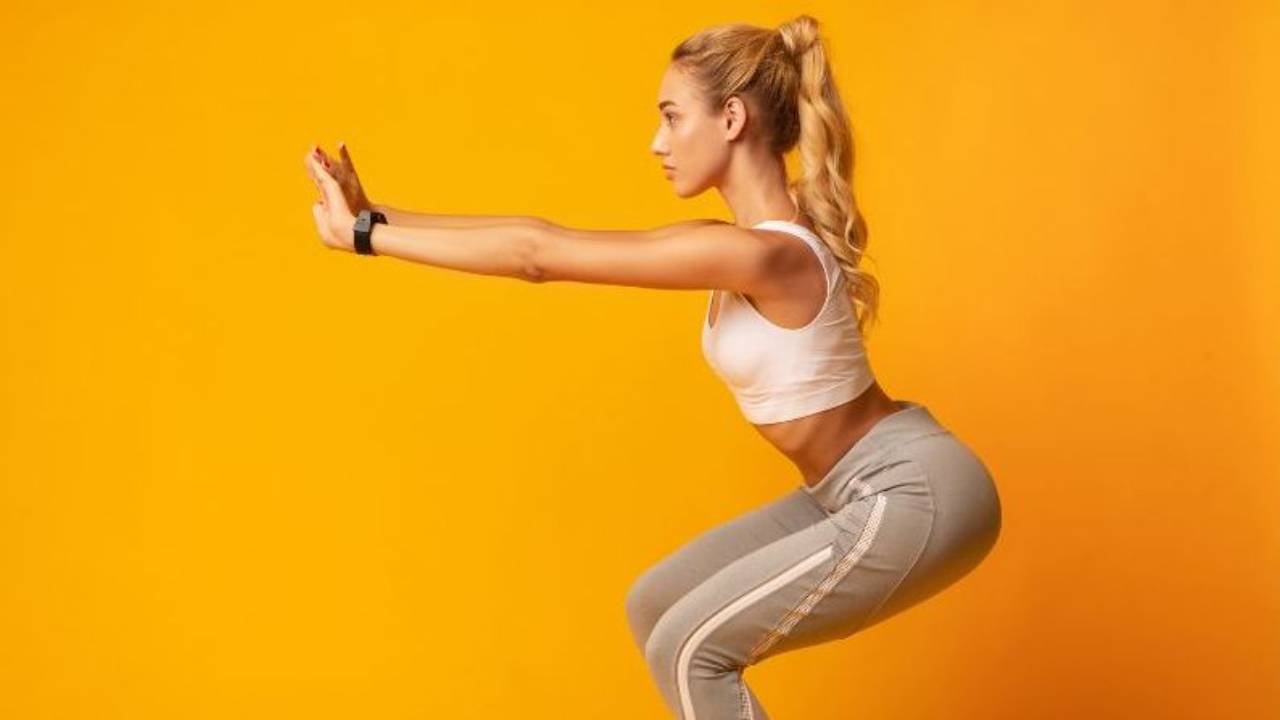
NASM Low Back Arch: Why Does Your Low Back Arch During a Squat?
Oct 19, 2026If you’re studying for the NASM CPT exam, low back arches is one of the movement compensations you need to recognize during the Overhead Squat Assessment.
But instead of simply memorizing that the low back arches, it helps to understand why it happens.
Once you understand the movement, the overactive and underactive muscles become much easier to remember.
Want to see the movement explained visually?
You can also review the complete assessment here:
NASM Overhead Squat Assessment Guide
Is Some Low Back Arch Normal During a Squat?
Yes.
Your low back naturally has a curve, so you are not looking for a perfectly flat back during the squat. The distinction is between a small, natural arch and an excessive arch that becomes very noticeable during the squat.
Think of the difference between a normal curve and a dramatic “ski slope” appearance.
It is that excessive arch that we are concerned with when studying the NASM Overhead Squat Assessment.
Why Does the Low Back Arch?
To understand the compensation, start at the hips.
As you lower into a squat, your hips move into hip flexion.
The hip flexors run along the front of the hips and thighs. When they become too short or tight, they can pull the pelvis forward.
Try visualizing it this way:
Tight hip flexors → pelvis tilts forward → low back arches
That forward tilt of the pelvis changes the position of the low back and creates the excessive arch you see during the squat.
Think of the Pelvis Like a Marionette Puppet
One of the easiest ways to understand this is to imagine a marionette puppet.
Picture the hip flexors as strings attached to the front of the pelvis. If you shorten those strings, what happens?
They pull the front of the pelvis forward and downward.
As the pelvis tilts forward, the low back arches.
This is why it is more useful to understand what the muscles are doing to the body than to simply memorize a list of muscle names.
The First Pattern to Remember: Front of the Hips vs. Back of the Hips
Now we can begin connecting the movement to the muscle imbalance.
Start with a very simple front-to-back relationship:
Front of hips = hip flexors = tight
Back of hips = glutes = weak
The glutes are hip extensors, so they perform the opposite action of the hip flexors. For studying this compensation, thinking in terms of front of the hips versus back of the hips can make the pattern much easier to remember.
We’ll break down the complete overactive and underactive muscle list in Part 2.
Free NASM Overactive & Underactive Muscles Chart
If you’re trying to memorize all of the NASM movement compensations, you don’t need to learn each one as an unrelated list.
Our free study chart puts the major compensation patterns together in one place so you can see the relationships between the overactive and underactive muscles.
Download the Free NASM Overactive & Underactive Muscles Chart
What Happens to the Low Back?
The hip flexors are only the beginning of the pattern.
Once the tight hip flexors pull the pelvis forward, the muscles of the low back also become shortened or tight.
For the NASM CPT exam, you may see these muscles referred to as the lumbar extensors. You may also see the erector spinae, one of the primary lumbar extensor muscles, listed by name.
That gives us another important piece of the pattern:
Hip flexors = tight
Low back/lumbar extensors = tight
But there is another side to this.
If the low back is tight, what is on the opposite side of the body?
The abdominal muscles.
And that brings us to the bigger pattern.
The Low Back Arch Creates an “X” Pattern
Instead of memorizing four unrelated facts, picture an X across the pelvis and low back:
Tight hip flexors ↗ Tight low back
Weak glutes ↗ Weak abs/core
The hip flexors on the front of the body are tight, making the low-back muscles on the back also tight. Opposite the hip flexors, the glutes are weak. Opposite the low back, the abdominal/core muscles are weak.
That gives you the basic pattern:
Tight: Hip flexors + low back
Weak: Glutes + abs/core
Once you understand that relationship, you are no longer trying to memorize four random answers.
You can reason your way through the pattern.
What About the Other Muscles?
There are additional muscles associated with the low-back-arch compensation.
The lats are tight and the hamstrings are weak.
So the complete muscle list is more than just hip flexors, glutes, low back, and abs.
That is exactly what we’ll cover next.
Next: Which Muscles Are Overactive and Underactive When the Low Back Arches?
In Part 2, we’ll take this movement pattern and turn it into the muscle list you need to know:
- Hip flexors
- Lumbar extensors/erector spinae
- Latissimus dorsi
- Glutes
- Hamstrings
- Intrinsic core
More importantly, we’ll organize them into a pattern so you don’t have to memorize them individually.
Continue to Part 2:
NASM Low Back Arch – Overactive & Underactive Muscles
Then in Part 3, we’ll put everything together into a simple strategy for remembering the low-back-arch pattern for NASM CPT questions.
Part 3 – How to Remember the NASM Low Back Arch Muscle Pattern
Test What You Know
Understanding the pattern is one thing. Recognizing it when it appears in a question is another.
Use the free NASM CPT practice test to see how well you can apply what you’re learning:
And if you want help preparing for the entire exam—not just the Overhead Squat Assessment—you can learn more about the complete CPT Academy prep program here:
CPT Academy NASM CPT Prep Course
Previous Articles, in case you missed them:
- Overhead Squat Assessment walkthrough
- Feet Turn Out series
- Knees Cave In series
Download Your Free Study Resources
📄 Download the FREE Muscle Compensation Chart to reinforce every movement compensation covered in this series.
🎥 Watch the Complete Muscle Imbalance Playlist for video demonstrations of each compensation.
🧪 Take the FREE NASM Practice Test to assess your understanding of corrective exercise and movement assessments.
🎓 Need More Help Preparing for the NASM CPT Exam? Explore the complete CPT Academy Prep Course for in-depth video instruction, quizzes, and guided study resources.
Don't miss a beat!
New moves, motivation, and classes delivered to your inbox.
We hate SPAM. We will never sell your information, for any reason.
Author