Understanding Muscle Knots: The Science of Adhesions, Davis's Law, and Corrective Exercise
Jun 10, 2026Looking for a description on key terms for the NASM exam? First check out Part 1 in our Reciprocal and Autogenic Inhibition Series!
Why "Muscle Knots" Are One of the Most Misunderstood Topics in Fitness
Almost everyone has experienced what they call a muscle knot.
You feel a tight area in a muscle. It feels stiff. It may be uncomfortable. It may even limit movement.
The problem is that most people stop there.
What NASM teaches us is that understanding muscle knots is about much more than simply finding a tight muscle. To understand corrective exercise, we need to understand what is happening inside the tissue, why it happens, and how it contributes to muscle imbalances.
The good news is that once you understand a few simple rules, this entire topic becomes much easier.
Prefer to learn from a VIDEO?
The Big Rule
A muscle does not become chronically tight for no reason.
There is always an underlying cause.
Many times, what we call a "muscle knot" is actually an adhesion.
Understanding adhesions is one of the keys to understanding why muscles become overactive.
What Are Adhesions?
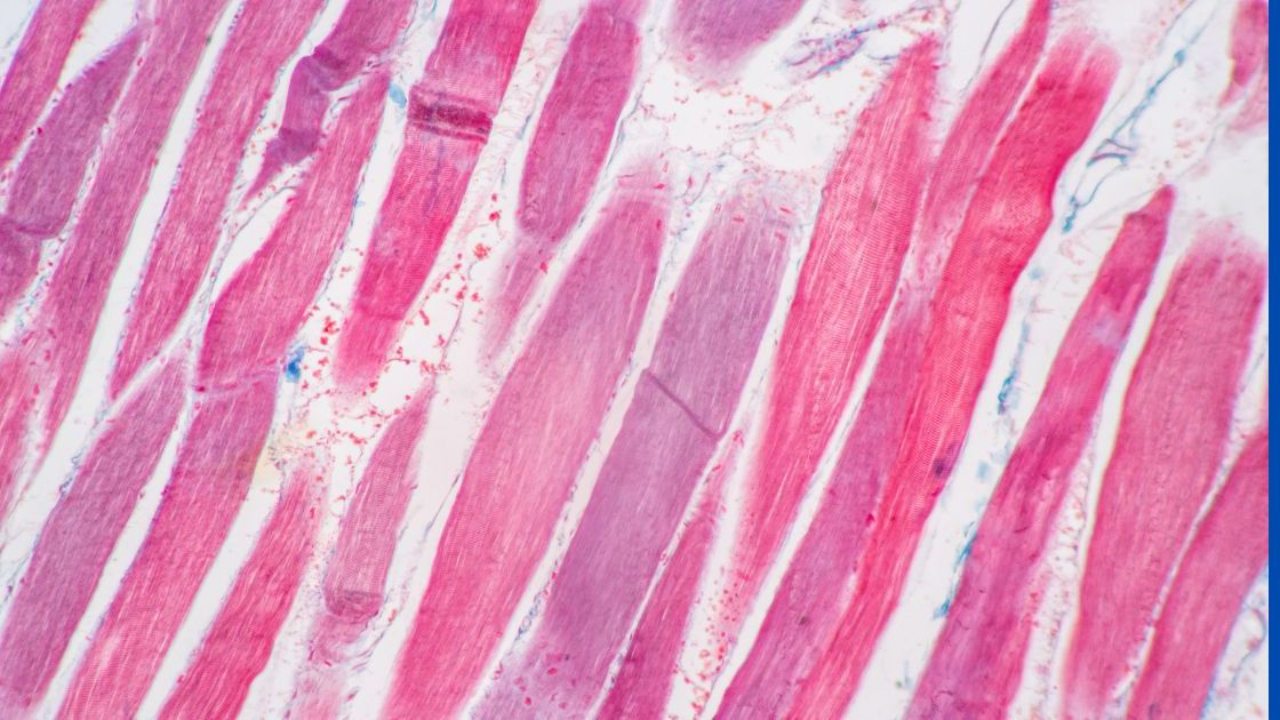
Adhesions are areas within muscle tissue where fibers become stuck together instead of gliding smoothly.
Think about how healthy muscle tissue should function.
Muscle fibers should:
- Lengthen
- Shorten
- Slide past one another
When adhesions develop, that smooth movement becomes restricted (that section of muscle fiber is "bunched" up).
The tissue becomes less elastic.
Movement becomes less efficient.
This is what many people experience as a muscle knot.
Simple Rule
Muscle "knots" are often symptoms of adhesions.
The tightness you feel is frequently the result of tissue restrictions rather than simply a muscle being "too short." Ironically, many adhesions throughout the body aren't even experienced as pain. Most people have overactive/tight calves, but few of those report their calves as a problem.
🎯 Test Your Understanding
Muscle knots, adhesions, and overactive muscles are common NASM CPT exam topics.
Practice identifying these concepts with our free NASM-style practice questions.
Why Adhesions Matter
The body is designed for efficient movement.
When adhesions develop, movement quality decreases.
As motion becomes restricted:
- Range of motion decreases
- Compensation patterns develop
- Certain muscles become overactive
- As a result, other muscles become underactive
This is where adhesions begin to connect with the muscle imbalance concepts we discussed in Part 1.
The Connection to Muscle Imbalances
Remember the chain reaction:
Muscle Imbalance → Altered Reciprocal Inhibition → Synergistic Dominance → Arthrokinetic Dysfunction
Adhesions often contribute to the first step.
Restricted tissue creates abnormal movement.
Abnormal movement creates compensation.
Compensation is observed through faulty joint motions.
🔥 Continue Building the Foundation
If you haven't read Part 1 yet, start there first.
You'll learn:
- Muscle imbalance
- Altered reciprocal inhibition
- Synergistic dominance
- Arthrokinetic dysfunction
These concepts form the foundation for everything discussed in this article.
👉 Read Part 1: Understanding Muscle Imbalances
Understanding Davis's Law
One of the most important concepts for understanding adhesions is Davis's Law.
Davis's Law states that soft tissue models along the lines of stress.
In simple terms:
Your body lays down new cells in the same pattern as the old ones. If the old cells have "knots", they will be replaced by new cells that follow that pattern.
WhyTypical Stretching Often Doesn't Work
One of the biggest mistakes people make is stretching in an ineffective way. Their muscles will temporarily lengthen...but ONLY as far as the bunched up knots allow. Until you dissolve those knots, the problem will continue.
📚 Want a Complete Corrective Exercise System?
Our NASM CPT Prep Program walks through exactly how to identify overactive muscles, underactive muscles, and the corrective exercise strategies used to address them.
👉 NASM CPT Complete Test Prep Course
The Overactive vs Underactive Muscle Rule
One of the simplest corrective exercise principles is this:
Overactive Muscles
Need to:
- Be lengthened
- By dissolving knots!
Underactive Muscles
Need to be:
- Strengthened
- Activated
- Integrated
This is the foundation of the NASM Corrective Exercise Continuum.
Why Overactive Muscles Stay Overactive
Some people assume overactive muscles are extra strong.
That is not true.
An overactive muscle is often:
- Working too much
- Working too often
- Working when it shouldn't
Adhesions can contribute to this process by restricting movement and encouraging compensation patterns.
As the body searches for ways to complete a movement, certain muscles begin doing more than their fair share of the work.
Eventually they become chronically overactive.
An equally important issue is with the partner muscle that they lengthen/weaken/make UNDERactive. When it's time for those to fire as the prime mover, their action is inhibited by the overactive partner muscle.
👉 More on Overactive/Underactive Muscles
👉 If you still need more help, we offer a mini-course just on Overactive/Underactive Muscles!
🎯 Free NASM Study Resources
You can also learn more with our free resources (Q&A, videos, articles).
Correcting Tight (Overactive) Muscles
When addressing overactive muscles, NASM generally follows a sequence:
Step 1: Inhibit
Use self-myofascial techniques such as foam rolling to systematically dissolve adhesions in overactive tissues.
Step 2: Lengthen
Use stretching techniques to improve extensibility.
Step 3: Activate
Strengthen the muscles that are underactive.
Step 4: Integrate
Reinforce proper movement patterns on both sides of the affected joint through integrated exercise.
The Corrective Exercise Mistakes Most People Make
#1 - They foam roll incorrectly (not holding on a tender spot without moving until the knot releases).
#2 - The underactive muscles were never addressed/strengthened.
Without releasing, activating, and integrating, the body returns to the same compensation pattern.
How Adhesions Affect Performance
Adhesions do more than create discomfort.
They can affect:
- Flexibility
- Stability
- Movement efficiency
- Force production
- Exercise technique
- Greatly increased risk of injury through improper movement patterns
The body performs best when muscles move freely, allowing joints to pull efficiently.
When restrictions develop, performance often declines.
📝 Practice Applying These Concepts
The fastest way to learn corrective exercise is through application.
Work through NASM-style questions and identify:
- The overactive muscles
- The underactive muscles
- The appropriate corrective strategy
The Bridge to Part 3
At this point, we understand:
- Muscle imbalances
- Adhesions
- Davis's Law
The next question becomes:
Why do some techniques reduce muscle tightness while others don't?
To answer that, we need to understand the science of:
- Muscle spindles
- Golgi tendon organs (GTOs)
- Length
- Tension
These concepts explain why stretching, foam rolling, and corrective exercise work.
🔥 Continue the Series
In Part 3, we'll cover:
- Muscle spindles
- Golgi tendon organs (GTOs)
- Length versus tension
- What activates each receptor
- How to use GTOs to reduce muscle tightness
👉 Read Part 3: Understanding Length vs Tension
Final Takeaway
Most people think muscle knots are simply tight muscles.
In reality, many muscle knots are the result of adhesions and tissue adaptations.
Understanding Davis's Law helps explain why these restrictions develop.
Understanding corrective exercise helps explain how to address them.
The key is remembering:
- Soft tissue adapts to stress
- Adhesions contribute to restrictions
- Restrictions contribute to compensation
- Compensation contributes to poor joint motion
Once you understand those relationships, corrective exercise starts to make much more sense!
Ready to Pass the NASM CPT?
If you'd like structured lessons, practice exams, study guides, compensation charts, and a proven system that has helped students achieve a 95%+ pass rate, check out our complete NASM CPT Prep Program.
Don't miss a beat!
New moves, motivation, and classes delivered to your inbox.
We hate SPAM. We will never sell your information, for any reason.
Author