

Heart Circulation Explained: Blood Flow Steps, Terms, and Functions (NASM CPT Guide)
Apr 22, 2026Heart Circulation Explained: A Complete Guide to Blood Flow and Key Terms
Understanding how blood flows through the heart is an important concept for the NASM CPT exam—and for truly understanding how the body functions.
The challenge isn’t just memorizing the steps.
It’s understanding:
- The order of blood flow
- The terminology
- And how everything connects together
In this guide, we’ll break it down in a simple, logical way so you can actually remember it and apply it.
👉 Prefer to learn with a video?
Why Heart Circulation Matters
There are often a disproportionate number of questions about the heart on the exam.
That means this is not a topic you want to:
- Skip
- Memorize loosely
- Or misunderstand
👉 We cover this topic, and the other major science content, in our Basic Science Crash Course.
Basic Heart Structure (Think of It Like a Duplex House)
The heart is divided into two separate sides:
- Right side
- Left side
These sides are separated by a wall and do not mix.
Each side has:
- Atrium (top chamber)
- Ventricle (bottom chamber)
Think of it like a two-story duplex house:
- Top floor = atrium
- Bottom floor = ventricle
Oxygenated vs Deoxygenated Blood
One of the most important distinctions:
- Blue = Deoxygenated (low oxygen)
- Red = Oxygenated (high oxygen)
Understanding this helps you track where blood is going and why.
The 3 Main Functions of Blood
Before we follow the path, understand what blood actually does:
Blood functions:
- Transport (oxygen, nutrients, hormones)
- Regulate (temperature, pH, fluids)
- Protect (immune response, clotting)
Blood Vessels (The Pathways of Circulation)
Once blood leaves the heart, it travels through vessels.
Arteries
- Carry blood away from the heart
- Think: A = Away
Veins
- Carry blood toward the heart
Capillaries
- The exchange point
- Where oxygen and nutrients are delivered
- Where waste is collected
This exchange process is called:
Diffusion-
Movement of substances between blood and tissues
👉 Want more quick tips - check out our NASM CPT Test Tip of the Day video series!
The Step-by-Step Blood Flow Pathway
This is the most important section.
If you can visualize this flow, you’ll master most questions.
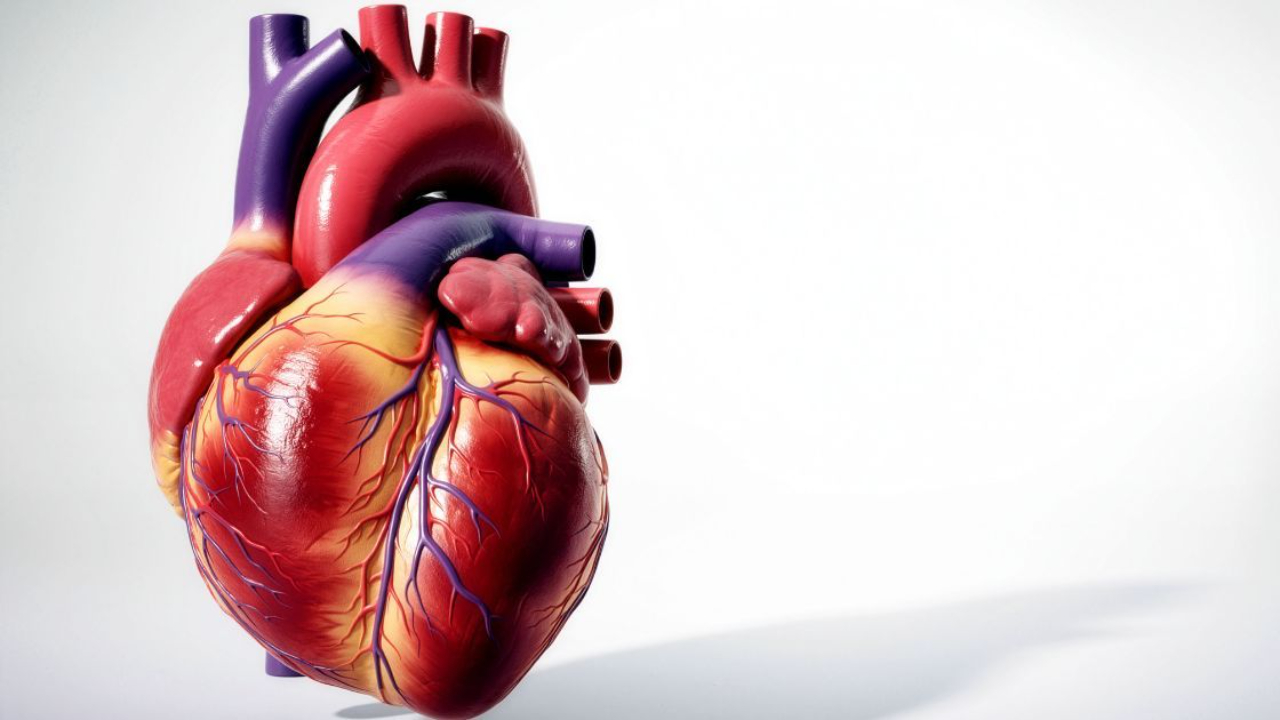
Pro tip: look at your picture and trace the steps!
Step 1: Blood Enters the Right Atrium (upper left side)
- Deoxygenated blood returns to the heart
- Enters through the vena cava
Step 2: Right Atrium → Right Ventricle
- Blood flows downward (top → bottom)
Step 3: Right Ventricle → Lungs (Pulmonary Artery)
- Blood is pumped away from the heart
- Travels to the lungs to pick up oxygen
Step 4: Gas Exchange in the Lungs
- Blood releases carbon dioxide
- Blood absorbs oxygen
- Blood becomes oxygenated (red)
Step 5: Lungs → Left Atrium (Pulmonary Vein)
- Oxygen-rich blood returns to the heart
Step 6: Left Atrium → Left Ventricle
- Blood flows downward again
Step 7: Left Ventricle → Body (Aorta)
- Blood is pumped to the entire body (***to deliver the oxygen we picked up at the lungs***)
- This is the main distribution point
Step 8: Capillary Exchange
- Oxygen is delivered to tissues
- Waste is collected
Step 9: Return to the Heart
- Blood travels back through veins
- Re-enters via the vena cava
Then the cycle repeats.
👉We have you covered with Overactive/Underactive Muscles too.
Understanding the Vessel Progression
As blood moves through the body, vessels change size:
- Arteries → Arterioles → Capillaries → Venules → Veins
Key idea:
- Arterioles = small arteries
- Venules = small veins
Key Terms You Must Know
Stroke Volume
Amount of blood pumped per beat
~75–80 mL per beat
Heart Rate
Beats per minute
Cardiac Output
- Total blood pumped per minute
- Combines volume + frequency
Resting Heart Rate
Typically 60–100 bpm
Why This Matters for Trainers
You’re not just memorizing anatomy—you’re understanding:
- How oxygen gets to muscles
- How performance improves
- How fatigue occurs
This directly impacts:
- Program design
- Cardio training
- Recovery strategies
👉 We cover this and ALL NASM content in our Full CPT Prep Course - 37 hours of video instruction, 750+ practice questions with explanations, and a full practice test!
How to Actually Remember This
Don’t try to memorize random steps.
Instead, think of it as two loops:
Loop 1: Heart → Lungs → Heart
(Pick up oxygen)
Loop 2: Heart → Body → Heart
(Deliver oxygen)
If you remember those two loops, everything becomes easier.
Final Thoughts
Heart circulation isn’t complicated—it’s just detailed.
Once you understand:
- The flow
- The terminology
- The purpose
Everything starts to click.
And when it clicks, this becomes one of the easiest sections on the exam.
Looking for additional resources?
If you want a simplified, step-by-step breakdown of all NASM concepts (like this one), check out:
👉 Full CPT Prep Course
👉 Basic Science Crash Course
👉 Top Tips for Passing the NASM CPT Exam in 2026
Don't miss a beat!
New moves, motivation, and classes delivered to your inbox.
We hate SPAM. We will never sell your information, for any reason.
Author